

News & Insights
Photo courtesy of: Greg Land
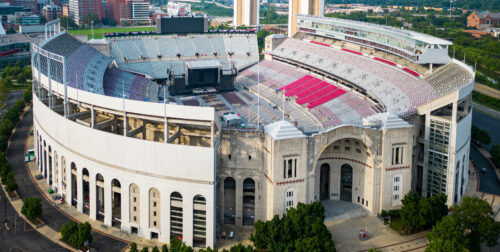
In venue design, sustainability is often discussed in terms of systems: energy use, water performance, materials, waste diversion, and carbon reduction.
All of those matter.
But as architects, owners, and operators look more seriously at the full lifecycle of sports and entertainment venues, another truth is becoming harder to ignore: the most sustainable building is often the one that can keep serving its community without needing to be replaced.
That requires a broader definition of sustainable venue design. It is not only about how efficiently a building performs on opening day. It is about how intelligently it can adapt over 20, 30 or possibly 40 years of changing fan expectations, event formats, technologies, operating models, climate conditions, and community needs. For some venues, long-term value may also include the ability to support the community during disruptions, not just on event days, but during heat waves, storms, outages, or other emergencies.
For venue owners, this is not just a design question. It is an asset strategy question: how to preserve optionality, protect long-term value, and avoid locking the building into a single version of the future.
A venue that cannot accommodate usage trends will eventually force a difficult decision: expensive renovation, functional obsolescence, or demolition. A venue designed for adaptive reuse gives owners more options. It protects embodied carbon. It preserves civic memory. It extends the useful life of major public and private investment.
In other words, longevity is a sustainability strategy.
Sports and entertainment venues are among the most complex building types weencounter. They must accommodate intense peak demand, long periods of lower activity, specialized back-of-house operations, rapidly evolving technology, premium hospitality, broadcast requirements, food and beverage service, security, transportation, and an emotional connection to place.
No design team can fully predict how all of those factors will evolve over the life of the building.
That is why flexibility has become one of the most important measures of performance. The question is not whether a venue is perfectly tailored to today’s program. The question is whether it has the capacity to absorb tomorrow’s program.
The best venues are not static objects. They are frameworks for change.
Climate Pledge Arena in Seattle demonstrates this at a major arena scale. Rather than erase the former KeyArena entirely, the project preserved the landmark roof and reimagined the building beneath it as a modern, high-performing sports and entertainment venue. The result is not nostalgia. It is transformation. The arena retained a meaningful piece of Seattle’s civic identity while creating a venue that supports the NHL’s Seattle Kraken, the WNBA’s Seattle Storm, concerts, and major live events.
That approach matters because demolition is not neutral. When a building is replaced, the environmental cost is not limited to the new structure. It includes the loss of embodied carbon already invested in the existing asset. Adaptive reuse changes that equation. It asks what is still valuable, what can be retained, and what must be reconfigured to meet current and future needs.
Climate Pledge Arena’s sustainability story is widely recognized, including its achievement as the first arena in the world to receive International Living Future Institute Zero Carbon Certification. But its deeper lesson is architectural: sustainability and reinvention are not competing priorities. In the right project, they are the same strategy.
There is a persistent misconception that adaptive reuse means accepting limitations. In practice, it often requires more creativity, more discipline, and more technical coordination than starting from a clean site.
Existing buildings have constraints. Column grids, rooflines, structural capacity, historic features, loading access, floor-to-floor heights, and urban context all shape what is possible. But constraints can also create clarity. They force the project team to decide what matters most.
Portland Center Stage at The Armory offers a different but equally important example. Originally built in 1891 as the National Guard Armory Annex, the building was transformed into a performing arts venue that became the home of Portland Center Stage in 2006. The project achieved LEED Platinum certification and became both the first building on the National Register of Historic Places and the first performing arts facility in the United States to reach that level.
That is more than a preservation success story. It is a lesson in how adaptive reuse can create layered value.
The Armory is not simply an old building with a new tenant. It combines performance spaces, rehearsal areas, production support, public gathering areas, offices, and community-facing uses inside a historic structure. It contributes to Portland’s cultural life while preserving the character and material memory of the original building.
For venue owners, that is the larger opportunity. Adaptive reuse can turn an underperforming asset into a platform for new programming, new partnerships, and new forms of community relevance. It can reduce environmental impact while strengthening identity.
New construction will always have an important place in venue development. Some sites, programs, and market conditions require it. But the industry should be careful not to treat newness as the default measure of ambition. Sometimes the more ambitious act is to make an existing building work harder, smarter, and longer.
Planning for longevity is not only a design decision. It is a leadership decision.
It requires owners, operators, architects, engineers, municipalities, and community stakeholders to think beyond the opening event. It requires capital planning that looks past the first cost and considers lifecycle return. It requires early conversations about adaptability, maintenance, operations, revenue generation, and future use.
Most importantly, it requires asking better questions at the beginning of a project:
Those questions are not secondary to sustainability. They are central to it.
The next generation of sustainable venues will not be defined only by certification plaques or efficient systems, though both remain important. They will be defined by resilience, adaptability, and civic usefulness over time.
The venues that endure will be the onesdeveloped not as finished products, but as long-term assets with the capacity to evolve. For owners and communities, that is the real promise of adaptive reuse. It protects the past without being trapped by it. It reduces waste while creating new value. It allows a venue to remain relevant across generations. The greenest venue is not always the newest.
It may be the one built to change.
David Almany is a Senior Associate with Brailsford & Dunlavey’s Venues team, where he advises collegiate and professional sports organizations on athletic facilities, entertainment venues, and mixed-use development projects. With more than 20 years of experience as an architect and design leader, he has managed large multidisciplinary teams and worked on high-profile sports and hospitality projects with internationally recognized architecture firms. At B&D, he guides clients through the full project lifecycle—from early planning and strategy through design, construction, and implementation oversight.
Dave Karlsgodt is Vice President of Brailsford & Dunlavey’s Infrastructure, Energy & Sustainability practice, where he leads climate action planning, energy and utility strategy, public-private partnerships, and energy efficiency initiatives for higher education and public-sector clients. He combines technical expertise with business strategy experience, having previously led his own software development and consulting firm and advised organizations on carbon mitigation, energy transition, and infrastructure planning. At B&D, he helps institutions develop long-term sustainability and infrastructure strategies that align operational performance with environmental goals.


