

News & Insights
Photo courtesy of: Greg Land

How post-occupancy assessments improve future planning, design, and operations
Organizations invest millions of dollars and years of planning into designing and constructing new facilities. After opening a new building, many organizations move on to future projects without understanding how end users are experiencing those spaces and whether the facility is helping the organization advance its mission and achieve its goals.
As a result, valuable feedback can remain scattered across work order systems, emails, phone calls, and side conversations. The loudest voices can begin to shape the narrative, even when they may not represent the broader experience. This leaves leadership and project teams with a critical knowledge gap: knowledge that can inform better decisions, improve processes, strengthen collaboration, and create more effective strategies for the future.
post-occupancy assessments allow organizations to build a representative understanding of their facilities, enabling evidence-based decisions and more impactful outcomes.
The opening of a new facility presents a learning curve for both end users and facility teams. System training, new protocols, daily management practices, and patterns of movement through the space are all refined as people learn how to operate and experience their new environment. As check-ins and support begin to taper off, end users develop routines and confidence in building systems, technology, and workflows. This is when feedback becomes even more valuable.
The building begins to prove itself.
Occupants begin to understand whether spaces truly support the way they work, learn, live, or gather. Facilities teams discover what is challenging to operate and maintain. Visitors experience the building’s entrances, signage, circulation, and security. This is where leadership has the opportunity to understand whether the facility is delivering the outcomes that justified the investment.
Each group holds a piece of the story, but a single voice is only an anecdote. Our goal is to identify patterns across end-user groups, systems, and buildings to create meaningful evidence that can guide better decisions.
A post-occupancy assessment is a structured process for evaluating how a facility performs after it is occupied.
A credible assessment is intentionally layered. It brings together multiple stakeholder perspectives using a combination of surveys, interviews, focus groups, building data, and other engagement methods. Participation is designed to be accessible through multiple languages and formats, while questions are developed with organizational leadership and subject matter experts to reflect each organization’s goals and priorities.
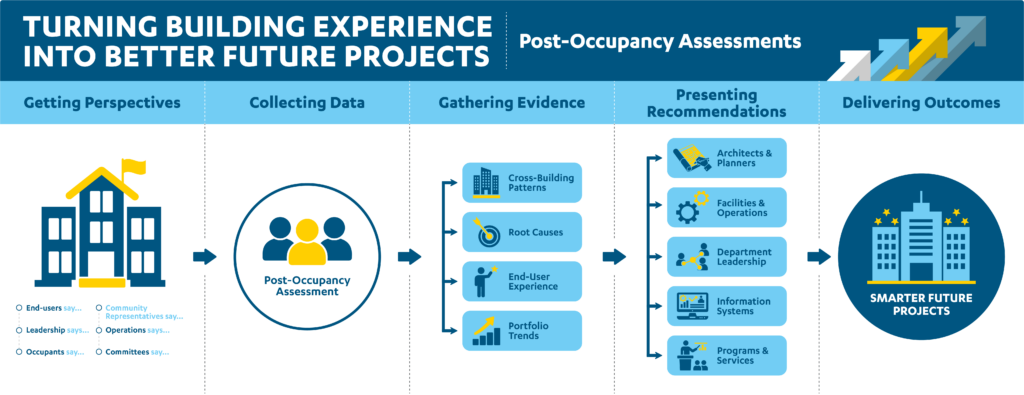 Assessments are also tailored to the people completing them. The questions asked of occupants, facilities staff, leadership, visitors, and other stakeholder groups should reflect their unique experiences and interactions with the building. The strength of a post-occupancy assessment lies in how these elements together to build a complete, representative understanding.
It can distinguish an isolated complaint from a recurring issue, a design problem from an operational one, and a temporary adjustment from a lesson that should influence future planning.
It can also identify what succeeded. Which spaces are working as intended? Which design decisions should be repeated? Which investments are improving the user experience or making the building easier to operate?
The goal is not to grade the building or assign blame. It’s to generate evidence that can inform hundreds of future decisions, from day-to-day operations to long-term planning and capital investments.
A post-occupancy assessment is particularly useful for identifying root causes.
Consider a new facility receiving repeated complaints about cleanliness. The immediate response might be to question the flooring, finishes, or custodial procedures. A broader assessment could reveal that the organization introduced specialty programming requiring more intensive sanitization or significantly expanded the facility without increasing the number of people responsible for maintaining it.
Likewise, technology that seems unreliable may point to insufficient training. Complaints about temperature may involve system performance, user controls, or confusion about how the system operates.
Buildings, staffing, technology, and operations are interconnected. Looking across multiple sources of evidence can reveal the larger issue.
The Massachusetts School Building Authority (MSBA), a government authority that helps fund public school construction in the state, has made post-occupancy evaluation a formal part of its capital project process.
The MSBA introduced its Module 9 post-occupancy evaluation framework to answer two questions:
After the MSBA completes its evaluation, each participating district receives a final report. The MSBA also enters the findings into a central database and can aggregate them into summary reports, public dashboards, and project advisories. According to the agency’s published evaluation manual, the purpose is not to grade individual designers, contractors, or school districts, but to identify recurring patterns and apply the lessons to future school projects.
That distinction matters. A completed school does not have to be treated as a closed chapter. When organizations collect findings consistently and preserve them across projects, the information strengthens future collaboration and decision-making.
Occupants and facilities teams need enough time to experience the building under low, normal, and high-traffic conditions. In most cases, an assessment is most useful after at least one year of regular use, to allow for a full heating and cooling cycle.
Organizations should consider one when:
A post-occupancy report should do more than summarize what people said. It should identify patterns, connect observations to operational data, distinguish symptoms from root causes, and show where further investigation or action is warranted.
Organizations often begin new projects by studying peer institutions and industry trends. Those benchmarks can be useful. But the most relevant source of evidence may be the buildings they already operate.
Before beginning the next capital project, ask a simple question: What are our completed buildings already telling us?
A post-occupancy assessment makes it possible to hear the answer clearly.
——–
Rachael Romano is a senior manager in Brailsford & Dunlavey’s Communications & Public Engagement practice group. She helps organizations gather, understand, and apply stakeholder perspectives to complex facility and capital planning decisions. She can be reached at rromano@bdconnect.com.


