

News & Insights
Photo courtesy of: Greg Land
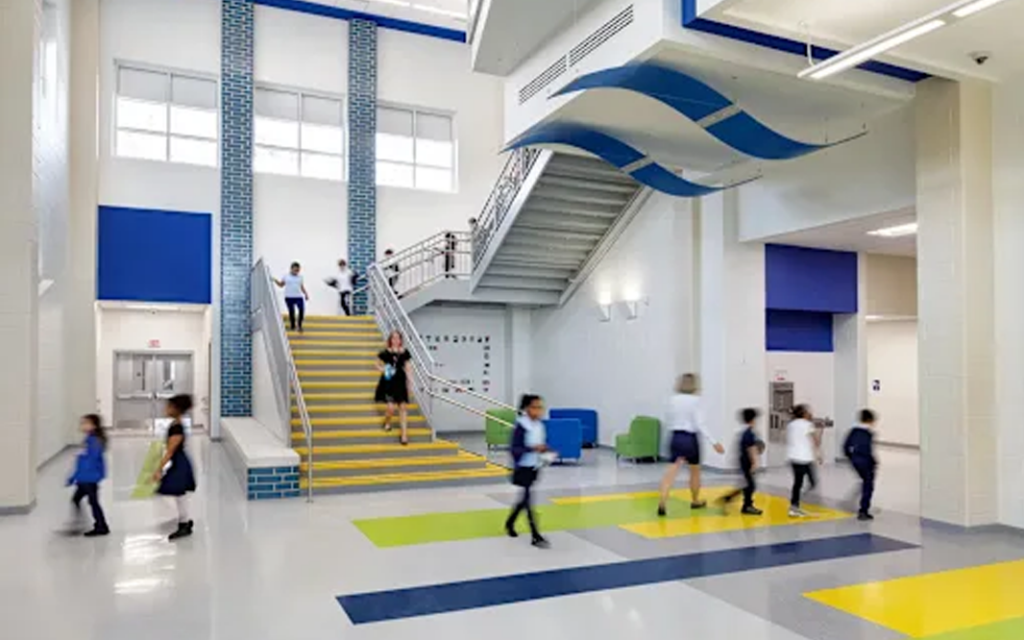
Years after opening, an Alexandria (Va.) K-8 school and recreation center combo continues to show what one campus can make possible
In May, B&D Vice President Jeff Bonvechio made the case that the future of public infrastructure is shared. Schools, recreation centers, libraries, and other civic facilities, he argued, can deliver greater value when public institutions plan them as parts of a connected community ecosystem rather than as isolated assets.
In Alexandria, Va., that idea has been operating at neighborhood scale since 2019.
The Patrick Henry K-8 School and adjoining Patrick Henry Recreation Center bring two public missions together on one West End campus. During the school day, the facility supports teaching and learning for kindergarten through eighth grade. Beyond the school day, recreation programs, fitness amenities, community rooms, athletics, and gathering spaces keep the campus active for residents.
The result is more than two buildings sharing a site. It is a long-term partnership between Alexandria City Public Schools (ACPS) and the City of Alexandria built around students, families, and community life.
The new Patrick Henry school and recreation center opened in January 2019, following approximately five years of joint planning and 18 months of construction. The $62.8 million redevelopment replaced an aging elementary school with a modern K-8 facility while expanding recreation capacity for the surrounding community.
The nearly 139,000-square-foot school increased capacity from approximately 650 students in the former pre-K-5 building to as many as 900 students in kindergarten through eighth grade. Adjoining it is a 19,000-sq. ft. recreation center with indoor walking and running lanes, a flexible court striped for basketball, volleyball, and pickleball, multipurpose rooms, and dedicated spaces for arts, fitness, and play.
Another 12,000 square feet (including a black box theater, full-size gymnasium, and multipurpose room) is shared by the school and recreation center. The arrangement allows spaces designed for student learning and activity to support a wider range of community uses beyond instructional hours.
“Patrick Henry demonstrates that shared use is not simply a design feature but an operating commitment,” said Amanda Ou, Executive Director of Facilities for ACPS. “The campus has to protect the school’s educational mission while remaining welcoming, functional, and accessible for the community. That requires continued coordination long after construction is complete.”
The challenge in a shared-use campus is not just deciding what to include, but planning how different users move through the same place at different times.
Patrick Henry was developed on an active, constrained site, requiring careful phasing, stakeholder coordination, and a mid-year transition into the new school. Its design also had to account for controlled school access, community circulation, storage, scheduling, custodial coverage, and the turnover of spaces from one program to another.
B&D supported the project through disciplined oversight of phasing, schedule, design review, stakeholder coordination, move-in, and turnover. The work helped translate the shared-use vision into a campus that could support safe, continuous school operations and broader public programming.
“A shared-use facility succeeds when the operational questions are addressed with the same rigor as the construction questions,” said Dan Nebhut, Senior Project Manager at B&D. “Access, scheduling, security, maintenance, and decision-making all have to be considered early. Patrick Henry offers a practical example of how coordinated planning can create value that extends well beyond opening day.”
Although the school and recreation center opened in 2019, the campus continued to evolve. The former school building remained in service as swing space during another ACPS modernization, delaying portions of the final outdoor plan.
In March 2025, the Alexandria community gathered to dedicate Patrick Henry’s completed multi-use field, marking the culmination of the broader redevelopment. The lighted synthetic-turf field is striped for soccer and baseball, serving Patrick Henry students during the school day before transitioning to City recreation programming after school.
Today, the Patrick Henry Recreation Center remains open into the evening and on Saturdays. Its indoor and outdoor amenities support fitness, youth and teen programming, community classes, meetings, play, athletics, and everyday recreation. The campus continues to function as the community hub envisioned during planning.
In November 2025, the Virginia School Boards Association recognized Patrick Henry with a Silver Design Award, honoring the campus as a community hub that integrates a modern school and recreation center under one roof.
The award reflects what the project has represented from the beginning: a coordinated public investment in education, recreation, wellness, and neighborhood connection.
Patrick Henry is not a universal template. Every school system and municipality brings different needs, resources, sites, and governance structures to a shared-use partnership. But the campus offers a durable lesson. The physical facility creates the opportunity; sustained coordination between public partners is what keeps that opportunity alive.
Years after the ribbon cutting, Patrick Henry continues to show what shared infrastructure can look like when a school and a city plan not only for the building they will open, but for the community life that will unfold inside it.


