

News & Insights
Photo courtesy of: Greg Land
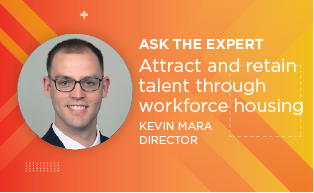
As housing affordability pressures continue to spread, especially across fast-growing metros in the South, colleges and universities are taking a harder look at how workforce housing fits into their long-term strategy. In this Ask the Expert, Kevin Mara, director in B&D’s Southeast higher education practice, talks about why workforce housing is becoming a serious recruitment and retention tool.
B&D: Tell us about your role at the firm.
Kevin Mara: I’m a director in the Southeast, and I help lead our higher education work across the region. I focus on facility planning, long-term strategy, and structuring public-private partnerships, whether that’s research centers, student and workforce housing, district developments, or energy and utilities. If it affects the physical campus, we’re probably involved in some way.
B&D: Workforce housing is becoming a bigger topic in higher ed. Where do you see the market today, especially in the Sunbelt?
KM: It’s definitely gaining momentum. What used to feel like a localized issue or a niche benefit is now affecting a much wider range of campuses and employees. The west coast has been dealing with this for a long time, but now it’s a national issue. Rural areas especially have been hit with disproportionate home price appreciation, where rental alternatives may be scarce or already filled with students. Universities in markets as diverse as Austin, TX and Boone, NC are seeing the need to intervene in this area. Both public and private institutions are realizing they need at least some housing inventory to stay competitive when recruiting and retaining faculty and staff.
B&D: These projects are expensive. How should institutions think about workforce housing as strategy instead of a “nice-to-have” amenity?
KM: There are many ways to help address employees’ housing challenges, and it can depend on your target population and local market. Rent, downpayment, or financing assistance; strategic acquisition versus new build; for-sale versus rental housing – retaining mid-career professionals will look different than attracting new faculty and staff. When we are talking about bricks and mortar, it really comes down making choices that find value. Universities should carefully consider design and construction standards and leverage efficiencies across existing campus operations. Residents can take advantage of amenities that already exist on campus. At the end of the day, this is about supporting the talented people who can advance the mission of the institution. If top people cannot see themselves succeeding in your market, you won’t be able to fulfill your mission. You can invest in infrastructure all you want, but without strong faculty and staff, it only goes so far.
B&D: Looking five to ten years ahead, what do you see for the future of workforce housing?
KM: Large operating subsidies probably aren’t sustainable for most institutions, so the more durable solution is building and controlling housing inventory over time. Affiliated foundation or partnership structures can help transfer risk in some cases, but broadly, if a university controls its own housing, it has options. It can increase rent 2-3 percent instead of the double-digit spikes that some markets saw in recent years, which reduces exposure to volatility.
From a real estate standpoint, the best time to build was yesterday. We have a deficit of over 4 million homes in this country, and while inflation seems to be easing nationally, median home sales price and average rent both are more than 30% higher today than in Q1 2020. Interest rates and insurance aren’t helping, and the personal savings rate is reflective of the broader K-shaped economy. The indicators suggest that this issue isn’t going away. Costs aren’t likely to drop in a meaningful way, so the sooner an institution moves, the stronger its long-term position will be.
B&D: Are there other programs that institutions should be thinking about in a similar way?
KM: Childcare is a big one. There’s a nationwide shortage, and it can be even tougher in smaller or fast-growing metros. For highly qualified professionals balancing demanding roles and family responsibilities, access to childcare can determine whether a move is even possible. Like housing, it’s a practical lever schools can use to support their people and strengthen their ability to attract top talent.
Thank you again to Kevin for participating in Ask the Expert. If there’s a topic you’d like one of our experts to cover in a future issue, submit it here.


